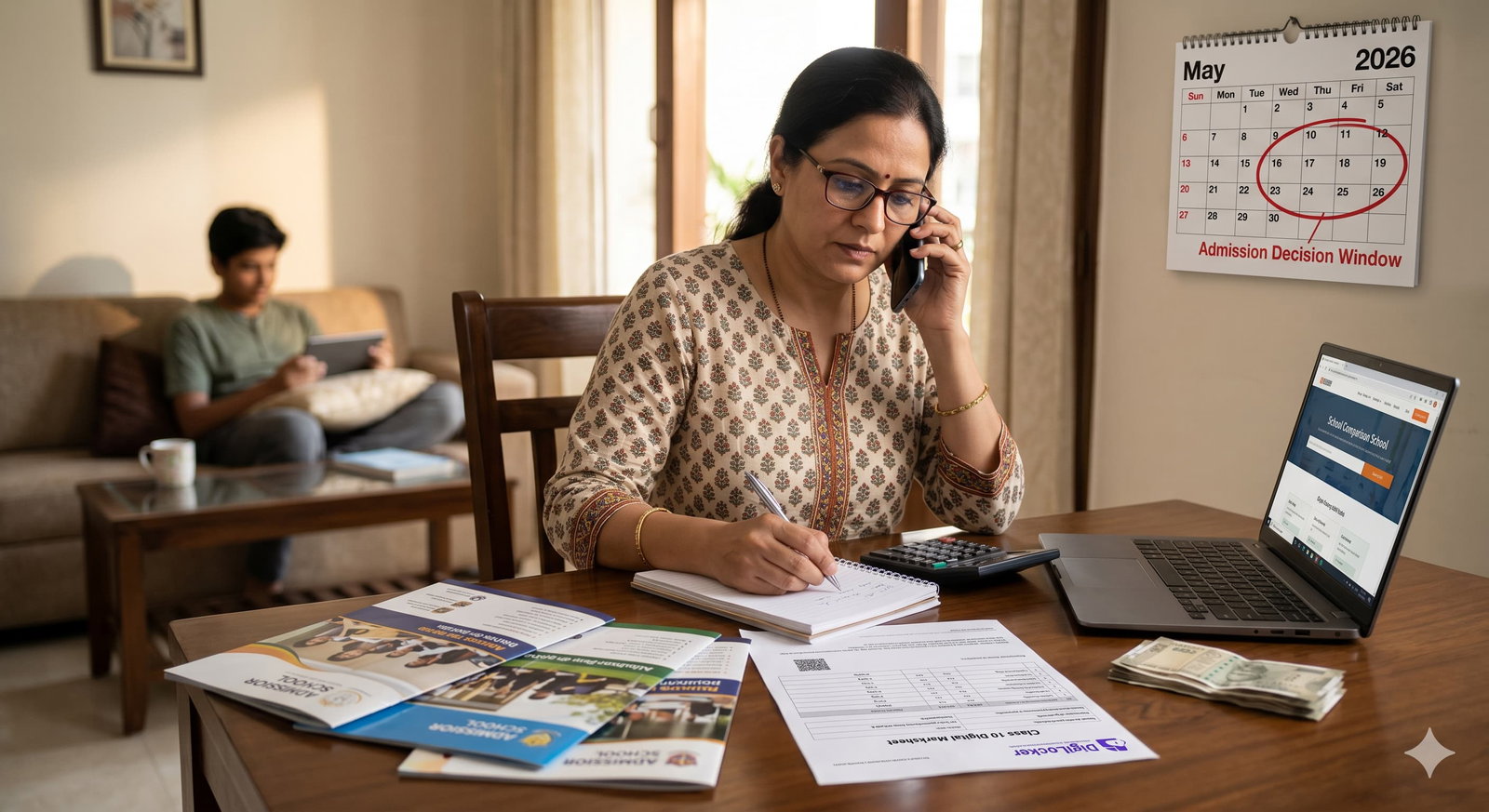
If you're reading this in April or May 2026, your child is days or weeks away from a Class 10 result — and you have about six weeks after that result to make one of the bigger decisions of their school life.
I'll be honest: most articles on this topic are written for the student. "Follow your passion," "choose what excites you." Which is fine advice, except you're the one who'll actually book the tour, sign the admission form, pay the fees, and sit in traffic for three years.
So this one is for you.
It covers the real decisions — stay or switch schools, which stream, what percentage actually gets your child into which school, and what to do if the result isn't what you hoped. No listicle padding. No fake toppers' quotes. Just the stuff I wish more parents knew before June hit.
The Question Most Parents Ask Last (But Should Ask First)
Every guide online starts with "Science, Commerce, or Arts?"
That's the wrong first question.
The real first question is: does your child stay at the current school for Class 11-12, or switch? Because stream choice depends entirely on where they'll study it. And in India, a school's Class 11-12 reputation is often completely different from its Class 1-10 reputation — different teachers, different peer group, different coaching culture.
Here's the sequence that actually works:
School decision first — stay, switch within the same board, or switch boards
Stream decision second — based on what that school actually offers well
Subject combination third — PCM vs PCB, or which optional subject
Flip that order and you end up choosing Science at a school whose Class 12 chemistry teacher retired last year and nobody told you.
The 3 Streams — Decoded for Parents (Not Students)
Every other guide gives you career lists. I'll give you the parent-lens version.
Science (PCM or PCB)
What it really commits you to: two years of coaching-class overlap. If your child takes Science seriously at a top school, they're likely also enrolled in a JEE/NEET coaching on weekends and 2-3 evenings a week. That's a second school, essentially, with its own fees (₹80,000-₹2,50,000/year), its own timings, and its own pressure cycle.
Parent reality check:
Time cost: 12-14 study hours/day by Class 12, including coaching
Money cost: school fees + coaching + test series + books — budget ₹3-6 lakhs/year for a realistic JEE/NEET prep
Flexibility: high — Science students can switch to Commerce/Arts for college; the reverse is nearly impossible
Choose Science if: your child has a genuine aptitude for math or biology (not "manageable marks" — actual interest), and your family can absorb the time/money load without resentment.
Commerce
What it really commits you to: fewer late-night study hours, but a more strategic game. CA, CFA, CS, CUET for B.Com at top Delhi University colleges — Commerce has multiple parallel tracks, and each has its own entrance prep.
Parent reality check:
Time cost: moderate — around 6-8 study hours/day, lighter coaching ecosystem
Money cost: lower than Science at Class 11-12 level, though CA coaching adds up post-12th
Flexibility: moderate — smooth path to B.Com, BBA, CA, economics. Harder pivot to engineering or medicine later
Choose Commerce if: your child is numerically comfortable but not obsessed, enjoys strategy/structure, and is likely heading into business, finance, law, or economics.
Humanities (Arts)
The stream India's middle class spent 20 years dismissing and is now quietly the smartest choice for a huge set of students.
What it really commits you to: more independent reading, better writing ability, and a much broader entrance-exam landscape — CUET for DU/Ambedkar/JNU, CLAT for law, design entrances, liberal arts entrances (Ashoka, Krea, FLAME).
Parent reality check:
Time cost: moderate, but shifts from rote to reading/writing — different muscle
Money cost: lowest of the three at Class 11-12; entrance coaching costs rise if targeting law or design
Flexibility: very high — law, journalism, psychology, UPSC, design, liberal arts, education, policy
Choose Humanities if: your child reads beyond the syllabus, argues well, writes with voice, or is drawn toward people-facing careers. "My child scored 75% so Arts is the only option" is a bad reason.
Stay or Switch Schools? A 6-Question Decision Tree
Answer these honestly. More "yes" to the stay questions = stay. More "yes" to the switch questions = switch.
Stay if:
The school has a strong Class 11-12 faculty in your child's target stream (ask to meet the subject teacher before deciding)
Your child is emotionally settled and has a peer group they'd miss
The school's past board results (not toppers — the average) are solid for that stream
Stream and subject combination your child wants is actually offered — confirm in writing
Switch if:
The school's Class 12 board average in that stream is significantly below neighbourhood peers
The subject combination you need isn't available (e.g., Economics + Math + Psychology)
You're moving for work and the current school doesn't have a branch/affiliation nearby
The current school runs coaching-friendly schedules that your child doesn't need, or refuses to accommodate external coaching
You need to switch boards — CBSE to IB/IGCSE for international applications, or into CBSE for JEE/NEET alignment
Most families overweight emotional comfort ("she has her friends there") and underweight Class 11-12 fit. Both matter, but the 11-12 years decide college — and college decides a lot more than Class 10 peer groups.
The Non-Stream Pathways Parents Usually Underrate
Everyone funnels their child into Science/Commerce/Arts because "that's what we did." It's worth knowing what else exists.
Polytechnic / Diploma (3 years): direct path after Class 10 into an engineering diploma. Entry into the 2nd year of B.E./B.Tech via lateral entry. Lower fees, earlier earning, fewer JEE headaches. Worth a serious look if your child is hands-on and the JEE circus feels misaligned.
ITI / Skill Trades: underrated. 1-2 year certifications in electrician, fitter, motor mechanic, plumbing, stenography. Government ITIs are heavily subsidized. For specific family businesses or early-earning goals, this is a legitimate path, not a consolation prize.
CBSE Skill Subjects: CBSE offers vocational/skill subjects (AI, data science, web applications, financial markets, marketing) that can be taken alongside a regular stream in Class 11-12. These don't replace a stream — they add a practical layer to a Science or Commerce combination. Not every school offers them; ask.
Open Schooling (NIOS): flexible Class 11-12 with exam slots through the year. Useful for children with significant health issues, competitive sports commitments, or families relocating mid-cycle. Not the first option, but a real option.
IB / IGCSE switch: if your child is college-bound internationally, the Class 11 transition is the sanest switch point. CBSE-to-IGCSE or CBSE-to-IB is doable but requires a clear reason — cost jumps 3-5x and Indian college admissions via CUET get more complex, not less.
The 6-Week Action Plan After the Result
Print this and stick it on your fridge.
Week 1 (Result Day + 7 days):
Download marksheet from DigiLocker / UMANG — don't queue for physical copies yet
Have a calm 30-minute conversation with your child about what they want — before you talk to any relatives
Shortlist 5-8 schools: 2 "stretch" (top cutoff), 3-4 "target", 1-2 "safe"
Week 2:
Call each shortlisted school's admission office — confirm stream, subject combinations, deadline
Request prospectus and fee structure in writing
If staying at current school, confirm the internal stream allocation policy in writing
Week 3:
Visit top 3 schools — meet subject teachers for your child's intended stream, not just the admission officer
Ask to speak to a current Class 12 student from that stream (any good school will arrange this)
Check commute in real traffic, not Google Maps optimistic
Week 4:
Apply to 3-4 schools in priority order
If compartment/re-evaluation is in play, file those applications in parallel — don't wait for revised scores
Week 5:
Attend entrance tests / interviews
If switching boards, collect Transfer Certificate, Migration Certificate (for board-switch), and character certificate from the current school
Week 6:
Confirm admission and pay the first instalment
Book coaching (JEE/NEET/CLAT/CUET) only after school is locked — timings need to align
What If the Result Isn't What You Hoped?
This is the section nobody writes properly, so I'll keep it short and real.
Compartment exam: if your child failed one subject, they get a supplementary exam. It doesn't stay on their final marksheet once passed. Don't let anyone tell you this "ruins" anything. It doesn't.
Re-evaluation and verification: there's a fixed window (usually 5-15 days after result). Low-cost, high-value if your child is even 2-3 marks below a cutoff they need. File it.
Lower-than-expected score: resist the urge to fix it in one conversation. Give your child 48 hours. The result isn't the child. The next two years matter far more than this one exam, and a calm Class 11 admission into the right school with the right stream has turned around plenty of "average" Class 10 students into strong college-bound ones. I've seen it repeatedly.
Considering a repeat year? Rarely the right call. Class 11-12 matters more, coaching for targeted entrances matters more, and a confident fresh start usually beats a reset.
FAQs Parents Actually Ask
Can my child switch from Science to Commerce in Class 12?
Technically yes at most schools, practically painful. The syllabus gap is a year of catch-up. Better to decide correctly at Class 11 entry.
Is CBSE easier than ICSE for Class 11-12?
Different, not easier. CBSE aligns with JEE/NEET/CUET out of the box. ICSE has stronger English and broader subject depth. If college entrance exams are the target, CBSE is the pragmatic pick for Class 11-12.
My child is confused about the stream. Should we get career counselling?
Worth it, but pick a counsellor who uses aptitude and interest assessments, not just personality tests. Budget ₹3,000-₹10,000 for a good session. Don't use it as a substitute for conversation with your child.
Do Class 11-12 marks matter if my child is doing JEE/NEET?
Yes. Most top engineering colleges now require 75%+ in Class 12 (CBSE aggregate). NEET-based medical admissions need 50% aggregate in PCB. Don't let your child ignore boards "because coaching matters more." Both matter.
What's the fee range I should budget for?
For a mid-premium CBSE school in Delhi NCR, Class 11-12 fees typically run ₹1-3 lakhs per year. Add coaching if Science/Commerce-CA. IB/IGCSE schools run ₹4-10 lakhs/year. Check our school listings for specific Class 11-12 fee structures.
My Take
To sum up, these six weeks between Class 10 results and Class 11 admission deserve serious attention:
Choose a school that suits the stream, not just the name or reputation
Choose a stream based on aptitude and interest, not pressure or trends
Keep family discussions calm and practical during this time
Shortlist options using clear data before making visits or calls
Avoid rushing decisions just to “close” the admission quickly
Best of luck :)